Friday, July 28, 2017
The Current Problem
Fair warning: I'm going to be cynical here. I don’t know how medical graduates can stomach $200,000 or more in student debt. Actually, it’s over $600,000 in debt if you factor in interest. I’ve heard the advice from other people: “Do what you really want to do and worry about the debt later”, “Follow your passion”, “You’ll be making more after so the debt won’t seem as large later”, and “Just worry about getting in and finishing,” “you’ll be paying more for a house later anyway.” I don’t know though. Taking on that much debt just gives me the heeby-jeebies. I don’t know how medical students are able to sleep at night having that loom over them constantly, and what with worrying about grades, working long hours, having minimal if any appreciation, and worrying about messing up anything with the patient -- that just seems like a recipe for a breakdown if you ask me. After what I’ve been through, being in my 30’s already, suffering heavy investment losses, major depression, and having a past with no money to begin with; I just cannot stomach that kind of expenditure, even if it would be for the most noble of causes (education, medicine, and helping people). It stings though because I know I can do it. I have the grades, the drive, the intellect, the perseverance, the prerequisites, and even a master’s degree in the sciences to help make things easier. The only thing I lack is the money! And for me, that is key: an unwillingness to go into more red. That is why this decision is so difficult for me. I can’t do it. The alternatives are really seeming more attractive to me. Thank God there are alternatives! It will mean disappointing people though, explaining myself, having slightly less prestige, which actually, I’m okay with. Even if people will see me as “less than” what I could have been, I could be okay with that -- but how will I see myself? When I have certain things that other people lack, but other people went through with this course anyway, and I’m not going to, voluntarily. How could I live with myself then?

Coming Back Again
I haven’t written in this in a long time. That’s okay. A journal can evolve into something else, with time, from what it was originally envisioned as. Otherwise, there wouldn’t be growth, or learning; it wouldn’t be a journey. I almost hope that no one reads this. It’s going to be a little more personal from now on. I say ‘almost’ because I do want certain people to read it. Although most likely the people I want to read it will not, and it will be read by other strangers entirely, and at that point I would have moved on already. Except, I do want it to stand as a record, if even only a personal one, that I did once think of this decision for a long time, and regardless of what path I will eventually choose, I want my future self to know that I made this decision with a lot of thought. I really struggled with myself about it, and that’s okay. At some point, I will make a decision, of what I will eventually do with myself. I want it to be the right one, so I’m going to be recording my thought process here. My hope is that one day I'll look back on it and smile, but even if I don't, I'll feel much better knowing that I put everything I had into making this decision.
Tuesday, September 24, 2013
Spinosaurus Tooth

Here is a fossil tooth I recently acquired, from a Spinosaurus, which is likely the largest carnivorous dinosaur, if not the largest land predator, that ever lived. It's somewhat difficult to say for certain as a complete skeleton has never been found (only scanty partial specimens). They have prominent dorsal neural spines for which various theories have been proposed. Some people think they were used for thermal regulation, others for sexual display, others to show aggression and dominance. It could also have been a hump. Regardless, this is one of the larger fossil teeth I own and one of my favorite specimens.
Spinosaurus Tooth
Kem Kem Beds, Morocco
Upper Cretaceous
70 million years old
Wednesday, September 18, 2013
Pyritized Ammonite
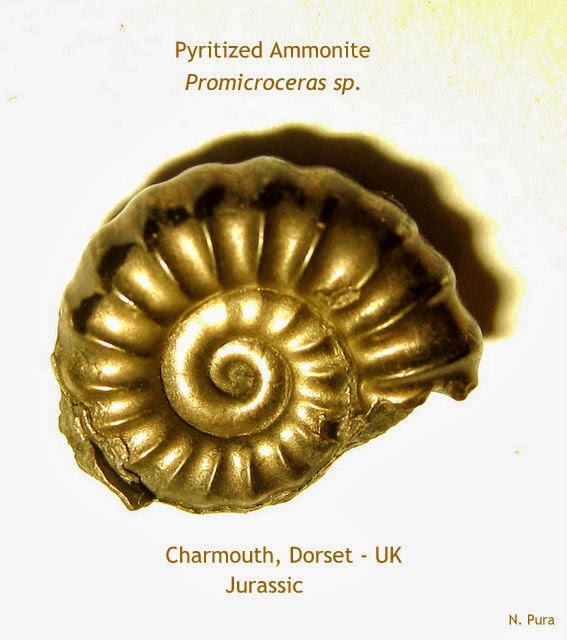
http://www.thefossilforum.com/index.php?/gallery/image/28933-pyritized-ammonite/
Monday, September 16, 2013
The Trilobite

No fossil collection would be complete without the trilobite. The trilobite is the most-studied fossil arthropod, and was likely the dominant life form during the Cambrian age (though they lasted well into the Late Permian). They were probably the first animal to have compound eyes. Their form is easy to recognize and enigmatically beautiful, like a strange visitor from an alien world. The trilobite is a boon to fossil collectors. Many species are quite common and readily available, though there is plenty of diversity around to satisfy the most exotic of tastes. This little guy holds a special place in my heart as one of my first fossils.
http://www.thefossilforum.com/index.php?/gallery/image/28462-flexicalymene-trilobite/
Thursday, September 12, 2013
Like a Dirty Snowball from the far-flung reaches of our Solar System
Some scientists believe certain meteorites to originate from comets, which have colloquially been termed "dirty snowballs" -- a mixture of frozen water and accreted stony material. Carbonaceous chondrites such as the CI chondrites have never been heated above 50°C during their formation and subsequent history. Otherwise, the water would have rapidly evaporated and the hydrous phyllosilicates would have been metamorphosed into other minerals due to the loss of water.
CI chondrites and the closely related CM chondrites are particularly rich in volatile substances, including water. It is possible that the CI meteorites could have originally formed in the outer solar system, at a distance greater than 4 AU (1 AU is the distance between our Earth and the sun). They were formed beyond our solar system's "snow line", a division representing a temperature of 160° K. At this temperature, any water present in the cometary/asteroidal body would have condensed to ice and been preserved. This is supported by the similarity of CI chondrites with the icy moons of the outer solar system, such as Europa and Triton. Based on mineralogical and chemical evidence, including the high deuterium/hydrogen ratio of CI meteorites, it is possible that the CI meteorites could be fragments of comets or extinct cometary nuclei. These are the extinct bodies of comets that have exhausted their volatiles, losing their tails, and subsequently being captured by the inner asteroid belt between the gravities of Mars and Jupiter.
CI chondrites and the closely related CM chondrites are particularly rich in volatile substances, including water. It is possible that the CI meteorites could have originally formed in the outer solar system, at a distance greater than 4 AU (1 AU is the distance between our Earth and the sun). They were formed beyond our solar system's "snow line", a division representing a temperature of 160° K. At this temperature, any water present in the cometary/asteroidal body would have condensed to ice and been preserved. This is supported by the similarity of CI chondrites with the icy moons of the outer solar system, such as Europa and Triton. Based on mineralogical and chemical evidence, including the high deuterium/hydrogen ratio of CI meteorites, it is possible that the CI meteorites could be fragments of comets or extinct cometary nuclei. These are the extinct bodies of comets that have exhausted their volatiles, losing their tails, and subsequently being captured by the inner asteroid belt between the gravities of Mars and Jupiter.
Here is an article discussing the outer asteroid belt origins of the Tagish Lake meteorite:
"Peter Brown and friends noted that the orbit of Tagish Lake extended to that part of the asteroid belt where asteroids classified by astronomers as C, P and D types predominate. These asteroids are know to have hydrated silicates (water-bearing minerals) on their surfaces, and because of their dark color, are suspected to be rich in carbon compounds. These are also characteristics of the most primitive meteorite types known -- the carbonaceous chondrites, especially the types classified as CI and CM. This was the first clue that Tagish Lake might be a primitive type of chondrite."
Thought to contain the most primitive matter in our solar system, could Tagish Lake have also been a comet in it's long and mysterious past? D-type asteroids are thought to have originated in the Kuiper Belt, a region of the solar system beyond the orbit of Neptune. Tagish Lake's characteristics strongly suggest that it is a primitive body coming from the far reaches of our solar system.
Wednesday, September 11, 2013
We too are stardust
Here is an interesting Scientific American article on the Murchison meteorite, and why I have unofficially dubbed it "The Biologist's Meteorite." Murchison was found to contain more than 70 amino acids, as well as other organics (purine and pyrimidine precursors) that may have provided the raw materials for life.
http://www.scientificamerican.com/article.cfm?id=murchison-meteorite
They say that you can actually smell the carbonaceous compounds in freshly-cut specimens. Well, I recently won an auction for one and will soon see for myself! Waiting for it to come in the mail is killing me!
Additionally, powdered samples of the Murchison meteorite, when heated up to 900°C, show strong similarities in their reflectance spectra to C- and G-type asteroids. G asteroids exhibit strong UV absorption, a good example being the large asteroid / dwarf planet 1 Ceres. C asteroids, additionally, are thought to be the parent bodies of the carbonaceous chondrites.
Murchison
http://www.scientificamerican.com/article.cfm?id=murchison-meteorite
They say that you can actually smell the carbonaceous compounds in freshly-cut specimens. Well, I recently won an auction for one and will soon see for myself! Waiting for it to come in the mail is killing me!
Additionally, powdered samples of the Murchison meteorite, when heated up to 900°C, show strong similarities in their reflectance spectra to C- and G-type asteroids. G asteroids exhibit strong UV absorption, a good example being the large asteroid / dwarf planet 1 Ceres. C asteroids, additionally, are thought to be the parent bodies of the carbonaceous chondrites.
Here is another (BBC Science) article discussing organics found in the Tagish Lake and Murchison meteorites:
Murchison
Tuesday, September 10, 2013
Allende
The Allende meteorite is the largest carbonaceous chondrite ever found on Earth. The bolide was witnessed on February 8, 1969; falling over the state of Chihuahua, Mexico. The Allende meteorite is notable for possessing many, large calcium-aluminium rich inclusions (CAIs), which are among the oldest objects formed in our solar system.
Some portion of the carbonaceous chondrites are thought to originate from 1 Ceres. While no meteorites have conclusively come from Ceres, it is possible that the reflectance spectrum of the surface of Ceres is not indicative of its crustal rocks.
The present models assume instantaneous cold accretion of Ceres from approximately 1-km-sized objects. These may have accreted earlier from solar nebula during a duration period of about 2.4 million years from nebula cooling and formation of CAIs. This means that Ceres may have evolved further from the simple aqueous thermal evolution found in CC meteorites.
Allende
Some portion of the carbonaceous chondrites are thought to originate from 1 Ceres. While no meteorites have conclusively come from Ceres, it is possible that the reflectance spectrum of the surface of Ceres is not indicative of its crustal rocks.
The present models assume instantaneous cold accretion of Ceres from approximately 1-km-sized objects. These may have accreted earlier from solar nebula during a duration period of about 2.4 million years from nebula cooling and formation of CAIs. This means that Ceres may have evolved further from the simple aqueous thermal evolution found in CC meteorites.
Allende
Tuesday, August 13, 2013
Elysium
Oh, I enjoyed Elysium. It's just that the film had two sides for me: a social agenda and an action story, and those two didn't necessarily work well together for me. The story didn't challenge me intellectually. It's been done before (and better) in other science fiction novels, and none of the emotional scenes really worked on me. Still, I found the movie as a whole rather enjoyable. Better than most I've seen this year. A surprise: Kruger is an amazing villain! The race-and-chase scenes were awesome, and the display of military technology had me drooling (just don't get me started on the physics involved, or lack of adherence to them. You've got to cut the line somewhere). Overall, not disappointed in the least.
Thursday, August 01, 2013
The deafness of deliberate solitude

At least he has his own devices, he can give himself that. Thinking to himself, who can fault them, for not seeing a thing that takes years of discipline and solemn inquiry to see? There is that certain kind of beauty that blooms in solitude, a rare flower that only grows under the most unexpected of circumstances. Wouldn't it be silly, to think that every seed would be exposed to the same photohydrological and chemical conditions? No, he would not assume that every sporophyte would remain the same. There is far too much left to be understood.
Sunday, July 28, 2013
Why do so many drugs fail to get FDA approval?


Some thoughts / notes on the topic of why so many drugs fail to get FDA approval:
- Efficacy-related failures
- Safety-related failures
- assess risk profile
- ex. systemic toxicity, tumorigenicity, arrhythmias, side effects
- Research, Manufacturing, & Commercial Processes
- optimized for one objective and not the other
- Suboptimal endpoints chosen
- clinical benefit difficult to measure
- disease progression
- overall survivability
- Control Group Problems
- Poorly-chosen Patient Populations
- broad vs. targeted
- Data Management
- Suboptimal data capture / entry
- Investigator bias
- Reporting bias
- Patient Enrollment
- Suboptimal inclusion / exclusion criteria
- Failure to meet enrollment goals
- Cannot recruit enough patients for clinical trial
- Although most patients do not have a problem with the drug; there is a need to redesign the trial
- ex. change the dosage, administration, or procedure
- Lack of money to redesign the trial and start the process over again

- Regulatory
- Key parameters must be clear
- establish criteria needed for safety
- Learning curve for both clinical operations and regulatory agencies
- Agencies fear bad press & litigation
- The framework is still evolving

caco-2 immortalized human epithelial colorectal adenocarcinoma cell line
is used to search for novel compounds to treat colorectal and other cancers
Tuesday, July 09, 2013
Miles to go before I sleep

I don't remember where I heard it from, but it seems rather fitting for today.
Looking at my fossils and meteorites is some comfort. One represents almost unfathomable time, the other almost unfathomable space. What a difference that seems juxtaposed against my present turbulence. What I would give for a little stability and a kind face.
Fossil Forum Gallery
Monday, July 01, 2013
A view into the past

Knightia alta Fossil
Early Eocene, 50 million years old
Green River Formation, Wyoming
Fossils are comforting in a way, because they remind us that time has existed eons before us into the past, and will continue to exist long into the future. It's almost enough to melt away present-day worries. In a hundred years, the world will be inhabited by entirely new people, and our worries & insecurities will be nothing more than a distant memory.
Noel's Vertebrate Fossils
Friday, June 14, 2013
To catch a fallen star
I just obtained my first three meteorites! It's amazing. Just last week I didn't know ordinary people could obtain meteorites. I thought that they were just for the very rich or the very lucky (who happened to be at the right place and the right time when a meteorite fell). With the internet, ingenuity, and the help of a small but very dedicated group of scientists, meteorite hunters, and hobbyists; meteorites have become much more widely available. These are the first three I've added to my collection. I have several more on their way, but I can barely contain my excitement with these. I love holding them in my hands and thinking about their origins in outer space.
My very first meteorite is called "Vaca Muerta". That means "Dead Cow" in Spanish. What can I say? You know I have to start things off with something colorful and peculiar. Here are some links to my collection in the Encyclopedia of Meteorites. You'll have to scroll down to "Noel Darlucio Pura" to see my actual pictures.
Vaca Muerta:
http://www.lpi.usra.edu/meteor/index.php?code=24142
Sikhote-Alin:
http://www.lpi.usra.edu/meteor/index.php?code=23593
NWA 869:
http://www.lpi.usra.edu/meteor/index.php?code=31890
My meteorite collection:
http://www.lpi.usra.edu/meteor/MetBullFindphoto.php?credit=Noel+Darlucio+Pura
My very first meteorite is called "Vaca Muerta". That means "Dead Cow" in Spanish. What can I say? You know I have to start things off with something colorful and peculiar. Here are some links to my collection in the Encyclopedia of Meteorites. You'll have to scroll down to "Noel Darlucio Pura" to see my actual pictures.
Vaca Muerta:
http://www.lpi.usra.edu/meteor/index.php?code=24142
Sikhote-Alin:
http://www.lpi.usra.edu/meteor/index.php?code=23593
NWA 869:
http://www.lpi.usra.edu/meteor/index.php?code=31890
My meteorite collection:
http://www.lpi.usra.edu/meteor/MetBullFindphoto.php?credit=Noel+Darlucio+Pura
Tuesday, June 11, 2013
Gene Regulatory Networks
A special feature from the Proceedings of the National Academy of Sciences on the gene regulatory networks that control animal development. These systems regulate the expression of thousands of genes in the course of embryonic development and have been evolving for billions of years.
http://www.pnas.org/cgi/collection/gene_reg
This page has a useful link to the 50 most-read and most-cited PNAS articles.
My paper on Bicoid-depending anterior-posterior patterning can be found here.
http://www.pnas.org/cgi/collection/gene_reg
This page has a useful link to the 50 most-read and most-cited PNAS articles.
My paper on Bicoid-depending anterior-posterior patterning can be found here.
Anybody home?
Not sure yet.
Just testing the waters.
Not exactly sure what I'm doing here, but I'm suddenly awash in memory.
Don't feel like starting all over exactly, but this place needs an entirely different approach.
Just testing the waters.
Not exactly sure what I'm doing here, but I'm suddenly awash in memory.
Don't feel like starting all over exactly, but this place needs an entirely different approach.
Sunday, September 28, 2008
A New Experiment
Something new I'm working on. It should keep me occupied in the next following months. Not sure yet how long I'll be keeping the domain.
www.PoetryBlog.org
www.PoetryBlog.org
Monday, February 19, 2007
Subconscious Ramblings #101
I haven't written in my blog in what seems like ages. I was once religious about this (updating it I mean), but recently I've been questioning what its objectives are and whether those objectives are still worth pursuing. At the moment, I will entertain the notion that it has no objectives. I once thought I could use it as a medium to find friends, or people who think similarly to how I do, but that idea quickly deflated and it became something akin to a notebook I use to sketch things or paste articles I could have found in a newspaper. As it goes, several things have happened in my life, and I'm not at comfort to discuss most of them in great detail. I will make a list of sorts, as that is really all I'm prepared to do, and you can make do with any of them as you will.
1. I will miss you dearly, Lauren, more than you or anyone could ever know.
2. I met the poet Rafael Campo a few days ago, while he was giving a poetry reading at the College of Physicians
3. The Mutter's Museum is a fascinating place to be, filled with skulls and portions of preserved human bodies. I was able to see it briefly while walking with Dr. Campo. It was an unnerving experience.
4. The interview went very well for the new job I am considering.
5. I hope pharmaceutical marketing will prove to be every bit as challenging and stimulating as I hope it will be.
6. I will try to stay interested in school, but it is hard when the topics are so theoretical and far-removed from any actual business. My recent experiences have made me interested in entrepreneurship, and I no longer think merely about genes and biotechnology.
7. My group didn't make it to semi-finalist phase of the Wharton Business Plan Competition, but I'm still satisfied with what I learned. I partially saw that this was coming.
8. I don't particularly believe in psychic experiences, but when I opened the doors of perception, I found a place of undeniable beauty and peace, and I thought for a moment that I would be alright. I sought to commune with an eternal and universal subconscious mind, and I felt that there was nothing to fear. I could feel the writhing minds and presences of people I know, and in the wide expanse of the universe, I wasn't alone.
9. I have a rather active and inescapable imagination.
10. This could be the last, but this is it.
Friday, December 01, 2006
Thursday, November 30, 2006
Not Knowing
I have a lot on my mind. I can’t even post it here because part of it is work-related. Part of it is people-related. Another part, a huge part, is money-related. What am I doing with my life?
Just yesterday I saw cancer patients getting surgery and having parts of their bodies removed. It wasn’t just teeth or organs underneath your skin that you never see. They were important parts-- like eyes, noses, and lips. Some of them will die.
When will I? Am I using my time here as best I can? I have avoided certain things, but maybe I should confront them. It will mean saying things I don’t wish to say. I will never know how much time I can possibly have.
Am I cutting my life short, stressing, burning myself out? or am I squeezing the most out of the short time there is?
Just yesterday I saw cancer patients getting surgery and having parts of their bodies removed. It wasn’t just teeth or organs underneath your skin that you never see. They were important parts-- like eyes, noses, and lips. Some of them will die.
When will I? Am I using my time here as best I can? I have avoided certain things, but maybe I should confront them. It will mean saying things I don’t wish to say. I will never know how much time I can possibly have.
Am I cutting my life short, stressing, burning myself out? or am I squeezing the most out of the short time there is?
Subscribe to:
Posts (Atom)